
The Hierarchy of the Autonomic Nervous System
Polyvagal Theory (PVT), developed by Stephen Porges, is an invaluable lens, not only in my therapy, but in my daily life. As a somatic therapist, PVT allows me to bring the autonomic nervous system directly into the our therapeutic work. PVT allows us to conceptualize what is happening in our bodies, in our nervous systems, so that old wiring can be modified and new patterns can emerge in our lives. In this way of working, we create enough space within ourselves to hold big emotions, conflicting feelings, along with the capacity for grounding and regulation.
“Once you understand the role of the autonomic nervous system in shaping our lives, you can never again not see the world through that lens.” –Deb Dana
As we work together, you will create autonomic pathways of safety and connection. Connection to yourself and connection to others.
Polyvagal Theory is organized by 3 guiding principles: autonomic hierarchy, neuroception, and co-regulation.
Autonomic Hierarchy
There are 3 parts or sub-systems to the autonomic nervous system as illustrated in the PVT ladder below.
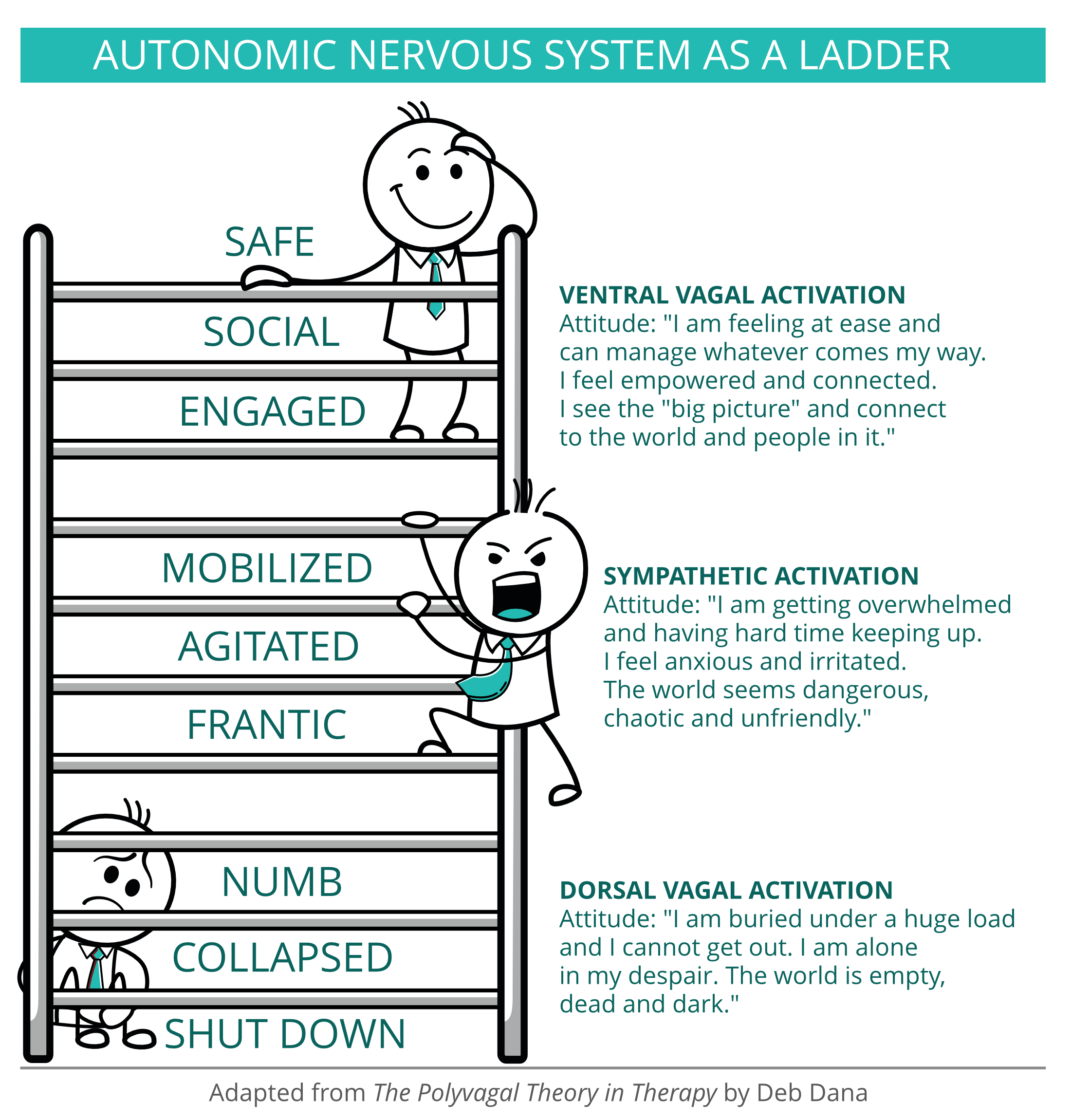
PVT allows youto visualize your autonomic nervous system like a ladder where you are continuously climbing up and down the rungs of physiological responses that correspond to emotional states.
When you understand PVT and practice it both in therapy and in daily life, you begin to recognize where you are on this ladder moment to moment. You get clarity around where your nervous system is at on this hierarchy. You will also learn how to return to a place of safety and regulation (ventral vagal).
Ventral Vagal
This branch of the parasympathetic nervous system allows for connection to others, bonding, and engagement.

The top of the ladder, the ventral vagal state, is where it feels like there is enough space within you to hold all your big feelings, even if they conflict. You feel connected to others around you and connected to yourself. The world feels expansive, full of possibilities, instead of constricting. You can think and feel at the same time because the logical parts of your brain are integrated with all that is held in your body. Growth and change feel within reach.
You feel a sense of safety through your whole body, not just know it in your head!
When the autonomic nervous system has moved into a dysregulated sympathetic or dorsal vagal state, your body and brain have been hijacked and they are held in a survival response. You move down the ladder leaving the felt sense of safety in ventral vagal.
Sympathetic
When your body detects a threat (real or perceived), your autonomic nervous system moves along the hierarchy in a predictable pathway towards protection. You move away from the connection and safety felt in the ventral vagal into the sympathetic mobilization of fight or flight. Perhaps there is a legitimate threat causing this shift – an oncoming car crossing the center line or your child wandering off in a crowded mall. However, our nervous systems can find signals of threat both externally and within our bodies, even if we are actually safe. Examples include a judgmental look on someone’s face, a social setting where you are expected to interact, an upcoming deadline at work, or the critical words your partner might say.

The energy of the sympathetic nervous system and the experiences of fight or flight are felt in the body. This is a survival response fueled by hormones of adrenaline and cortisol. Your breathing loses depth. Your heart rate increases. Your thoughts begin to spiral. Perhaps you shift into panic.
In a sympathetic state, your mind and body are searching for protection. You can no longer be open to connecting with others or even yourself. Survival is now the focus , and your body shifts into a readiness to act.
Dorsal Vagal
When your flight or fight responses do not resolve the distress you feel, no resolution was found by sympathetic mobilization, the autonomic nervous system again moves down the hierarchy, towards a state of collapse or shutdown.

The Dorsal vagal branch of the parasympathetic nervous system creates strategies of immobilization, such as the FREEZE response. Numb. Lifeless. Disconnected. Detached. Dissociated. The immobilization response is deemed necessary in the nervous system’s search for safety.
This is not a conscious choice, and it usually feels inescapable, yet necessary.
Once in a dorsal vagal state, returning to feelings of safety and connection (ventral vagal) is incredibly difficult.
Climbing Up the PVT Ladder – Return to the Whole You

Safe relationships, such as in therapy, will provide both internal and external resources to your nervous system, allowing you to regulate your emotions and climb back up the hierarchy ladder.
The pace is usually slow, especially if you have experienced trauma, but there is so much hope and freedom available. Your nervous system will learn to gently step out of a shutdown state, moving into the mobilizing energy of the sympathetic state of fight or flight, and then finally return to a place of feeling connected, safe, regulated, and socially engaged.
Perhaps you’ve never fully felt the freedom of a ventral vagal state. I tell my clients, if you can find it once, we can get you back there again and again. Nobody lives in a state of ventral vagal all of their days. We are designed to be flexible, shifting in and out of different states. But your ability to return to safety and regulation will truly be a marker of healing. This is where you finally feel whole and it is innately possible for you! Your were made for this!
References
Autonomic Nervous System as a Ladder. Felt Sense Psychotherapy. Retrieved August 25, 2025, from https://feltsense.co/blog/polyvagalpart1.
Dana, D. (2020). Polyvagal exercises for safety and connection : 50 client-centered practices. W.W. Norton & Company.
Porges, S. W. (2018). Polyvagal Theory: A primer. In S. W. Porges & D. Dana (Eds.), Clinical applications of the polyvagal theory: The emergence of polyvagal-informed therapies (pp. 50–69). W. W. Norton & Company.
Porges, S. W. (2011). The polyvagal theory: Neurophysiological foundations of emotions, attachment, communication, and self-regulation. W. W. Norton & Company.
 Mind and Body Therapy